
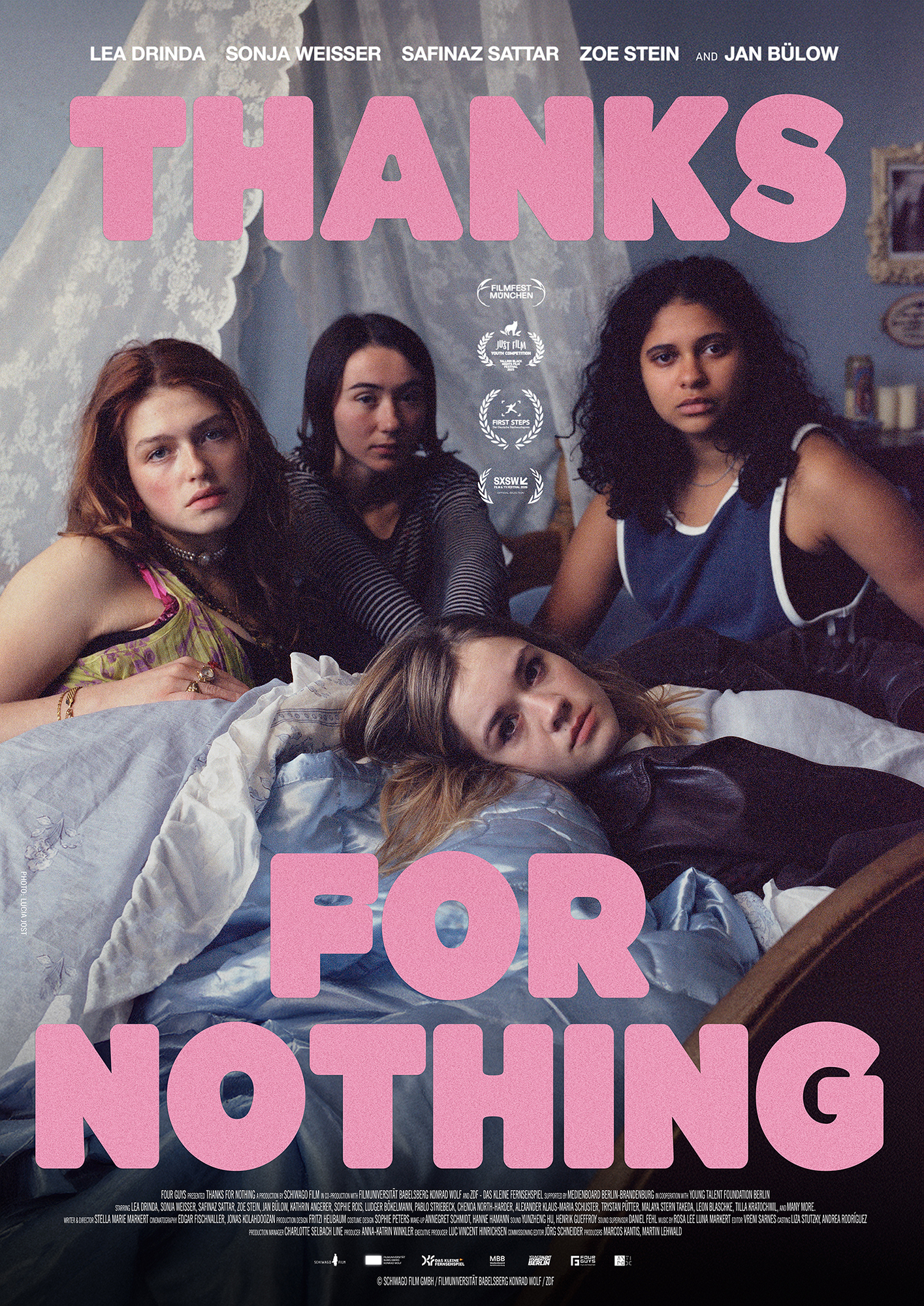
Thanks for Nothing
original title: Danke für Nichts
2025, 108 min., color, German
COUNTRY: Germany
PRODUCTION : BUDGET : 438 000 euro
CAST
Lea Drinda, Sonja Weißer, Safinaz Sattar, Zoe Stein, Jan Bülow
CREW
Director : Screenplay : Stella Marie MarkertCinematographer : Edgar Fischnaller, Jonas Kolahdoozan
Producers : Marcos Kantis, Martin Lehwald, Luc Vincent Hinrichsen
COMMENTS
FESTIVALS: SXSW 2026,Tromsø IFF 2026, Tallinn Black Nights FF / PÖFF 2025 (Just Film’s International Youth Competition – International Premiere), Black Forest Film Festival 2025, FilmZ Mainz 2025, Filmkunstmesse Leipzig 2025, International Film Festival Oldenburg 2025, Filmfest München 2025 (World Premiere)
DIRECTOR’S NOTES: THANKS FOR NOTHING isn’t a film meant to settle scores with the adult world. (Okay, that’s a lie—it kind of is. I mean, it’s literally called “Thanks for Nothing.”) But more than anything, it’s a film that grew out of its characters—out of that feeling of not being taken seriously, not being heard, as a young person. It’s almost as if the knowledge that teenagers experience everything more intensely-more painfully, more joyfully-triggers the opposite reaction in us: we take them less seriously. Which is exactly the wrong impulse, isn’t it…
That naturally brought in the social system too-not because I wanted to attack it, but because it’s the structure through which this story can best be told. It was never about criticizing social work itself, but rather about questioning rigid systems in general. Structures that make it harder to see people as individuals. Rules that still apply even when they clearly don’t make sense in a specific case. And those who enforce them-people you’ve probably met, especially in Germany.
I certainly have.
But I don’t want to get stuck talking about theory—that’s not what this film puts in the front row. It’s really about people. Characters born from my neighborhood, from my friends (and enemies), and from my own reality. A reality I often miss in portrayals of Berlin today. All told, of course, with a good dose of irony and exaggeration. Because we know: you don’t have to depict reality to tell something true. The goal isn’t to be “accurate” —it’s to be honest.
THANKS FOR NOTHING is a film about consequences…
If you asked me what this film is about, I’d say it’s about friendship. But if you asked me what it’s really about, I’d say it’s about the radical concept of unconditionality. A love between friends who couldn’t be more different-but love and respect each other because of it. An unconditionality I’ve been lucky enough to experience. And one I wish for everyone.


SYNOPSIS
Katharina, Ricky, Malou, and Victoria are four teenagers living in a group home – a place they’ve crafted in defiance of everything—parents, school, and society’s rules. With the dubious guidance of their social worker, Ballack, they’ve created their own little anarchic utopia. But Katharina, sick of the world and its expectations, is determined not to survive past 18. With her birthday looming in two weeks, her friends are scrambling to keep her suicide attempts under wraps, terrified that exposing the truth will destroy the only semblance of “home” they’ve ever known.
PRESS
“The camera is mostly handheld and constantly moving, subtly breathing with the characters and the rhythm of their interactions. Rather than observing from a distance, the camera exists within their shared space. As the story progresses and the bond between the girls deepens, the camera gradually moves closer. Early in the film, our close-ups remain slightly wider, maintaining a sense of distance. As trust grows between the characters, the camera becomes more intimate, reflecting their emotional closeness.” – directors of photography Edgar Fischnaller and Jonas Kolahdoozan to Sarah Shachat, IndieWire
“Katharina, on the other hand, is more the figure many of us wanted to be as teenagers. That depressive, mysterious female character was romanticised for a long time. Those untouchable girls were fascinating – characters like Effy from Skins or the girls in The Virgin Suicides. I didn’t want to parody that, but to comment on it.” – Stella Marie Markert to Teresa Vena, Cineuropa
Thanks For Nothing can be seen as the youths’ collective middle finger to all the adults who have ever failed them. Although the film deals with heavy themes, it is done with a tragicomic and slightly absurd approach, making the film a breath of fresh air. – Tromsø International Film Festival
Obviously for a debut: With dreamwalking certainty, the director masters the balancing act between humorous over-the brain brushes, creative ideas (such as breaking through the fourth wall or the black-humorous off-comment) and emotional, dignified view of the life realities of the four main characters…..Conclusion: With “Thanks for nothing”, Stella Marie Markert succeeds in a refreshing, remarkable directorial debt over four inappropriate young people who refuse to grow into a world consisting of norms, rules and narrow-mindedness. This amusing and unconventional story from the front to back is one of the strongest film debuts this year and also looks at the challenging topic of mental illness with respect and seriousness. So must be (young) German cinema! – L.A. Youth
In this darkly comedic tale of rebellion, abandonment, and surviving the absurd, “Thanks for Nothing” is the kids’ collective middle finger to the adults who have abandoned or failed them.- PÖFF
‘…Unconditional love, unconditional, you know, like you have to kind of make way for it… I want people to be more tolerant to each other and to be together, not to be isolate and enjoy life together. – PÖFF TV Meet the filmmakers – Stella Marie Markert interview
‘Punk-Attitüde und ein auffällig guter Soundtrack.’ – 4/5 Cineville
Der Film ist gespickt mit schwarzem Humor, emotional packenden Momenten und frischen Ideen. Und kann ein Film, der mit einem Rio-Reiser-Song endet, schlecht sein? Natürlich nicht! – 4/5 Cinema
Stella Marie Markert zeigt sich in ihrem Regiedebüt bemerkenswert stilsicher und fasziniert mit der morbiden Ironie des Alltäglichen. Nicht nur wegen des großartigen Darstellerensembles ist »Danke für Nichts« eine verdammt lebendige Frischzellenkur für das heimatliche Nachwuchskino. – Oldenburg Filmfestival
Stella Markerts Spielfilmdebüt liefert einen wilden Mix aus Tragik und Komik und betrachtet das Leben von Anhänger der Generation Y aus einer empathischen, aber auch authentischen Perspektive. Vor allem die Erzählstruktur bestehend aus vier Episoden, sowie Prolog und Epilog geben den Figuren genug Raum, um sich gleichmäßig zu entfalten und zeichnet ein nuanciertes Bild ihrer Hoffnungen und Zweifel. – Filmz Mainz
Auch das Gefühl der Freiheit und Verwegenheit des New Hollywood, das der Film mit der einen oder anderen Referenz herbeizitiert, stellt sich im Abspann tatsächlich ein. Nur das Ambivalente daran bleibt stets Behauptung: Mir jedenfalls scheint die Erkenntnis, dass man Ja zum Leben sagen, aber sich trotzdem eine Zigarette anzünden kann, nicht gar so widersprüchlich. – Nicolai Bühnemann, Perlentaucher
Mit extravagantem Erzählstil und lakonischem Humor behandelt Stella Marie Markerts Debütfilm auf ungewöhnliche Weise ernste Themen wie psychische Probleme und Suizidgedanken. – 4/5 Alexandra Seitz, Epd-Film
Aber Regisseurin Stella Marie Markert will in Danke für nichts eine Vierfach-Coming of Age-Komödie hinlegen, und da kommt es weniger drauf an, wie tief ein Film in die sozialen Abgründe schaut, sondern darauf, wie er erzählt wird. Und: Der Film ist toll erzählt, flott und energiereich, auch emotional, und immer nah an seinen Charakteren, die vom Jugendamt in das wirkliche Leben geführt werden sollen. Und die das vielleicht gar nicht wollen. – 4/4 Harald Mühlbeyer, Kino-Zeit
Von Sozialrealismus will die Inszenierung nichts wissen. Markert entdeckt vielmehr ziemlich lässig Kinoreferenzen. Wie im französischen Kino der 1960er- und 1970er-Jahre wird mit oft emotionslosem Gesichtsausdruck den unausweichlichen Katastrophen entgegengeraucht oder geflucht wie in alten Western. Der Abschlussfilm an der Filmhochschule Konrad Wolf wirkt ein bisschen wie „Hanni und Nanni“ als Film noir und ist in seiner trockenen, aber zugleich zärtlichen Tonalität doch außergewöhnlich ausgereift. – 4/5 Cosima Lutz, FILM Dienst
Stella Marie Markert beweist Mut zum Risiko, indem sie ein so ernstes Thema wie psychische Erkrankungen mit einem poppigen, flott montierten, zuweilen die vierte Wand durchbrechenden Inszenierungsstil und reichlich schwarzem Humor angeht. – Christopher Diekhaus, Programmkino
So muss (junges) deutsches Kino sein!
Der Produzentin und Filmemacherin gelingt mit ihrem unbekümmerten Mix aus Coming-of-Age, Großstadtballade und Tragikomödie (mit dem Schwerpunkt auf Komödie) eines der besten Debüts in diesem Jahr! Ein angenehm beiläufig inszenierter Film, der durch eine unverkrampfte Erzählweise und ganz, ganz viel Zuneigung für seine Figuren überzeugt. – 4,5/5 Björn Schneider, FILMSTARTS
Der Film Danke für Nichts ist ein bemerkenswertes Debüt, denn er zeigt eben nicht das vielfach gesehene “Vier Frauen – ein Problem”-Schema. Sondern begleitet seine Protagonistinnen durch ihre geschützte Zone, ihre Wohngemeinschaft. Die ist hier weniger Utopie, sondern Heterotopie – ein Ort abseits der üblichen gesellschaftlichen Regeln – in der die jungen Frauen unter dem Radar von Schule, Eltern und Jugendamt leben können. – Ivana Sokola, DEI ZEIT
So erzählt „Danke für Nichts“ nicht nur von belasteten Freundschaften, sondern auch von der Absurdität des Lebens – und davon, wie psychische Probleme oftmals belächelt, ignoriert oder kleingeredet werden.- Florian Meul, Choices